
Summary
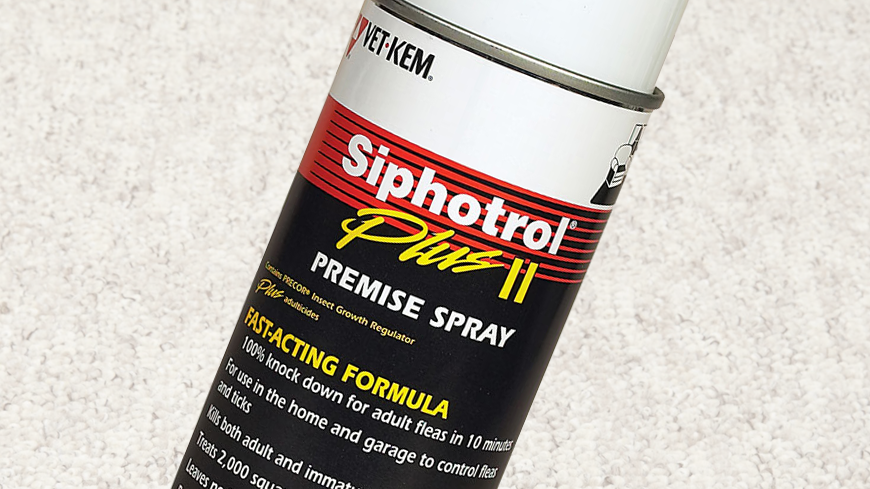
Siphotrol Plus II by Vet Kem is an insecticidal premise spray. It controls fleas and other indoor pests. Pyrethrins rapidly kill adult fleas. And (s)-methoprene stops eggs and larvae from becoming adults. Methoprene remains active indoors for 7 months to prevent re-infestation.
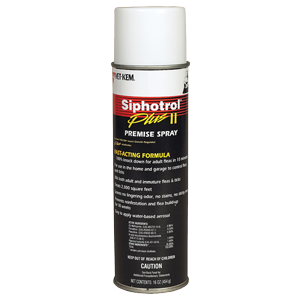
Siphotrol Plus II
Siphotrol Plus II controls and prevents fleas indoors for 7 months.
Other premise sprays are similar to Siphotrol in terms of active ingredient formulation. Thus, performance is comparable. The primary difference is price, with Precor 2000 Plus offering the best value.
| Product name | Siphotrol Plus II Premise Spray |
| Active ingredients | 0.085% (s)-methoprene 0.350% permethrin 0.300% phenothrin 2.000% MGK 264 1.400% piperonyl butoxide 95.865% other ingredients |
| Target pest | Fleas & ticks |
| Kills | Adults, eggs & larvae |
| Duration | 7 months |
| Size | 16 ounces |
| Capacity | 2000 sq ft |
| Application | Aerosol spray |
| Use on | Home premises |
| Manufacturer | Vet-Kem |
| UPCs | 041535063023 041535608002 885179920751 |
| Product label | view |
| MSDS | view |
| Shop | Amazon.com |
| Price | $21 |
| Customer reviews | Read reviews |
| Competitors | Browse premise sprays |
- Prices are based on Amazon.com at time of publishing.

Details
How Siphotrol Plus II Works
Methoprene
The most important ingredient in Siphotrol Plus II is (s)-methoprene (also called Precor). Methoprene is an insect growth regulator (IGR). It works by mimicking naturally occurring hormones in insects, specifically juvenile hormone. When exposed to an IGR, young insects can’t molt into the next stage of life. For example, flea eggs and larvae can’t complete their metamorphosis into adults. In addition, adult females are sterilized and can’t lay viable eggs.
The bulk of flea populations (95-99%) consist of eggs, larvae, and pupae. These immature fleas reside in the environment, usually at the base of carpeting. Adulticides are ineffective at killing these stages, because sprays can’t penetrate deep into carpets and they have a short-lived effect. IGRs are better suited because they remain active for 7 months indoors. The long-lasting residual activity is crucial for controlling fleas on troublesome surfaces. IGRs are also considered safer than conventional insecticides, because they mimic hormones that are rarely found outside of insects.
Permethrin & Phenothrin
The adulticides in Siphotrol are permethrin and phenothrin. These are two pyrethroids, a class of synthetic insecticides based on a botanical compound found in Chrysanthemum flowers (pyrethrum). Pyrethroids are commonly employed to kill adult fleas and other domestic insect pests. These insecticides are neurotoxins. They affect the insect’s nervous system by causing spasms, paralysis, and ultimately death.
When Siphotrol Plus II is sprayed, emerged adult fleas in the environment will be quickly killed. Unfortunately, only 1-5% of fleas will be in the adult stage. And once they find their way onto a host, the adults stay there. Thus, few adult fleas will be in carpets at any given time. This is why adulticides are less important than the IGR.
Many immature stages within carpets won’t be affected by the adulticides. The carpet matrix provides refuge from insecticide penetration and vacuum removal. As a result, the fleas currently developing in the environment may survive to emerge as adults. This can give the false impression that the spray didn’t work. However, the immature fleas living in the carpet will be the last generation. Any new eggs falling onto the IGR-treated carpets won’t develop.
MGK 264 & Piperonyl butoxide
Synergists don’t have insecticidal properties, but they boost the potency of pyrethroids. As a result, they’re often found together in pest products. Synergists allow less insecticide to be used, which results in safer and cheaper products. The two most common synergists are piperonyl butoxide and N-octyl bicycloheptene dicarboximide (MGK 264). Both are included in Siphotrol Plus II.
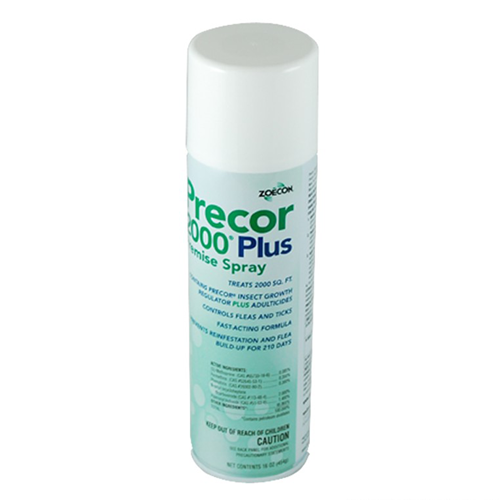
Precor 2000 Plus
Precor 2000 Plus is slightly cheaper than Siphotrol Plus II (may change).
Competitor Comparison
Siphotrol’s main competitors are Precor 2000 Plus, PT Ultracide, and Virbac Knockout. All of these products are aerosol premise sprays with similar active ingredients formulations. Price is the most noteworthy difference between them, and Precor 2000 Plus is the cheapest choice by a small margin.
Instructions
The following instructions were taken from the product label of Siphotrol Plus II. Before using the product, view the label for the full directions and precautionary statements.
READ ENTIRE LABEL BEFORE USE. NOT FOR USE ON HUMANS OR PETS.
Directions for Use
It is a violation of Federal Law to use this product in a manner inconsistent with its labeling.
SHAKE WELL BEFORE USING
FOR USE IN THE HOME/GARAGE/KENNEL
1. Identify treatment areas, especially those where pets frequent, such as in and around pet’s sleeping and resting areas. These are the primary areas where fleas, their eggs, and ticks are found. Before treatment, make a test application to upholstery, drapery, light-colored, delicate fabrics, or wood surfaces in an inconspicuous place.
2. Prepare treatment areas. Cover all food processing surfaces and utensils during treatment or thoroughly wash after product use. Cover or remove exposed food. Remove pets and cover and unplug aquariums before spraying. Remove motor vehicles before using in garages. For best results with Surface/Carpet treatments, vacuum thoroughly before spraying and discard vacuum bag in outside trash. This product may also be used for infested surfaces inside motor vehicles.
3. Apply treatment. For flea/tick infestations, a single can treats 2,000 square feet. Hold container upside down 2-3 feet from surface, point actuator towards the surface, and push button. Using a sweeping motion, apply a light uniform spray to all surfaces of furniture, rugs, carpets, drapes, and around all pet resting areas. Avoid thoroughly wetting surfaces. Mist treated areas only until “slightly damp”. Do not over-treat. Reapply in 14 days, if necessary. IMPORTANT: Only complete and proper application to carpets, upholstery, drapes, and other fabrics will provide thorough flea/tick elimination. Keep people and pets out of areas during treatment. Vacate room after treatment and ventilate until surfaces are dry before reoccupying.
4. For best results, eliminate fleas/ticks on your pet with appropriate Vet Kem® on-animal products
Storage and Disposal
Storage: Store in a cool, dry area. Do not transport or store below 32° F. Disposal: Do Not Puncture or Incinerate! If empty: Place in trash or offer for recycling if available. If partly filled: Call your local solid waste agency for disposal instructions.
Tips for Success
Target Hot-Spots
Flea eggs can fall anywhere the infested pet roams, but most will accumulate where the animal spends a lot of time. Flea hot-spots tend to occur where pets sleep, groom, and eat. In bedrooms, most fleas are found at the side or foot of beds, where animals sleep. Similarly, flea-prone areas in living rooms are often found next to sofas or animal bedding.
Spray the entire floor in infested rooms with a premise spray. However, give special attention to the potential hot-spots. And if follow-up treatments are needed, spraying can be limited to places where the majority of adult fleas are emerging.
Have Realistic Expectations
It’s important to have realistic expectations about flea control. No product or method will end an infestation immediately. Many immature stages develop deep within carpets, where sprays and vacuums can’t reach. Before the fleas are completely eradicated, all of these environmental stages must mature, emerge, and die. Usually it takes around 2 months before an infestation ends. This is why pet treatments are continued for multiple months.
After spraying Siphotrol Plus II, new eggs falling onto the floors shouldn’t be able to survive. However, a large portion of the young fleas already in the carpeting may be unaffected. They will eventually mature and emerge as the last generation of adults. Seeing these new adults can falsely make users think that premise sprays don’t work.
Pre-Emerged Adults
Pre-emerged adult fleas are a big control issue. After maturing, cocooned adults can enter into a quiescent (dormant-like) state for up to 5 months. However, they’ll quickly wake up and emerge upon detecting a host on the cocoon (heat and pressure). Vacuuming is a good way to simulate these host cues and trigger emergence.
Vacuuming Procedure
Vacuum carpets before spraying. Vacuuming will lift up the carpet fibers so the insecticide can penetrate deeper. Wait for the spray to dry before vacuuming again. Then vacuum at least every other day. Studies have shown that vacuuming shouldn’t reduce the efficacy of flea insecticides. Vacuuming may actually improve efficacy, as it causes cocooned adults to emerge into the adulticide which has a short-lived effect.
Premise Sprays Aren’t Enough
Adult fleas account for 1-5% of infestations and live on pets. Once they acquire a host, they won’t leave by choice. So, even with carpets treated, the adults will continue to thrive on untreated dogs or cats. Each female lays around 25 eggs a day. Flea eggs will drop wherever the pets roam. If they fall onto an untreated surface, then the infestation will continue.
This is why an integrated approach is the best way to control fleas. Treat the environment, treat pets, and establish a regular vacuuming routine. This kind of regime will result in establishing control quickly, and it will be easiest to maintain control until eradication.


You must log in to post a comment. Log in now.